October 30, 2020 by grammarcops
In the United States, Daylight Saving Time ends this weekend.
We want to note this interesting (and timely) grammar tip from WebExhibits:
Daylight Saving Time
Spelling and grammar
The official spelling is Daylight Saving Time, not Daylight SavingS Time. Saving is used here as a verbal adjective (a participle). It modifies time and tells us more about its nature; namely, that it is characterized by the activity of saving daylight. It is a saving daylight kind of time. Because of this, it would be more accurate to refer to DST as daylight-saving time. Similar examples would be a mind-expanding book or a man-eating tiger. Saving is used in the same way as saving a ball game, rather than as a savings account.
Nevertheless, many people feel the word savings (with an ‘s’) is mellifluous off the tongue. Daylight Savings Time is also in common usage, and can be found in dictionaries.
Adding to the confusion is that the phrase Daylight Saving Time is inaccurate, since no daylight is actually saved. Daylight Shifting Time would be better, and Daylight Time Shifting more accurate, but neither is politically desirable.
Source: WebExhibits: Daylight Saving Time

Posted in General, GrammarGab (quotes), GrammarGoofs & Gaff(e)s, Tips | Tagged confusion, correct, daylight, daylight saving time, daylight savings time, DST, grammar, language, learn, mistake, normal, pet peeve, question, saving, savings, time, usage, words, writing | 2 Comments »
October 13, 2017 by grammarcops
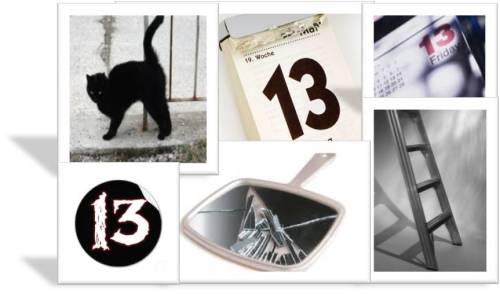
- Today is Friday the 13th. Twenty million Americans are feeling unlucky today–people who suffer from friggatriskaidekaphobia. It’s a 100+-year-old word made up of a combination of the Norse and Greek root words for ‘fear’ and ‘Friday’ and ’13.’
- Folklorists say that the phobia itself is a combination of two separate superstition-induced phobias–13 is unlucky in much of folklore and so is Friday. Whenever the first day of a month is a Sunday, there’s going to be a Friday the 13th that month.
- The number 13 has been unlucky for a long time. Numerologists point out that 12 is a complete number in Judeo-Christian culture: There are 12 months in a year, 12 hours on a standard clock, 12 Apostles, 12 tribes of Israel, 12 days of Christmas, 12 eggs in a dozen, of course, the 12 Steps of GRAMMARHOLICS (not so) ANONYMOUS, and so on.
- There’s something unsettling, even repugnant, about going just a bit ‘beyond completeness’–that’s how academic folklorists rationalize the superstition, at least. The vast majority of skyscrapers have no 13th floor, the room number 13 is missing from many modern hotels, and many airliners do not have a row 13 in their passenger seating.
- As for Friday, it’s unlucky in a handful of ancient cultures. In Christianity, it’s the day of Jesus’ crucifixion.
- There have been 12 films in the Friday the 13th series. The 13th came out on Friday the 13th of July in 2012.
- There are always the traditional folk remedies to ward off bad luck today: burning any socks with holes in them; eating some gristle while standing on your head; or climbing to a mountaintop. Just know that some years can have up to three of them.
Enjoy!
References: Dad, CBS News, The Skeptic’s Dictionary, IMDb
Posted in General, GrammarGarnish (wordplay), Vocabulary Builders | Tagged 12, 13, confusion, culture, definition, dictionary, English, fear, folklore, friday, friday the 13th, Friggatriskaidekaphobia, fun, grammar, language, news, phobia, question, usage, vocabulary, words, writing | Leave a Comment »
September 22, 2011 by grammarcops
Is it just us or has there been an increase in grammatical misuse in tag lines, advertisements, and TV commercials lately? As many of you know, we have been feuding with Hanes for a few years over their “lay-flat” collar ads – to no avail.
Looks like we have a couple of new opponents to take on:
StriVectin
“MORE SCIENCE. LESS WRINKLES.” & “More science. Less eye lines.”

FORD
“MORE GO. LESS STOPS.”
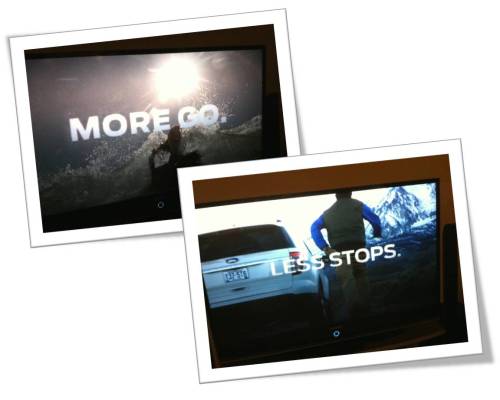
In addition, a faithful follower writes,
“Ugh! Have you seen the Mercedes commercial?! “More technology, less doors.” I’m hoping it’s really clever and I just don’t understand it. Surely the grammar couldn’t be that bad, could it?”
We encourage you to look back to our posts on the subject “Less” vs. “Fewer”.
Would these grammar goofs affect your buying decisions?
Posted in General, GrammarGoofs & Gaff(e)s, GrammarGrave (lost causes), Tips | Tagged advertisement, commercial, confusion, English, fewer, fewer vs. less, FORD, goof, grammar, Hanes, language, less, less vs. fewer, Mercedes, mistake, more or less, pet peeve, question, StriVectin, tv, usage, words, writing | 9 Comments »
September 17, 2011 by grammarcops
The other day, we were reminded of the 1922 novelty song by Frank Silver and Irving Cohn from the Broadway revue Make It Snappy, “Yes! We Have No Bananas.”
In this case, “Yes! We Have No Grammar” might be more appropriate for this Kroger gas station. Here’s the display we had to see while filling up the tank. Ouch!

Posted in General, GrammarGoofs & Gaff(e)s, GrammarGripes (pet peeves), PunctuationPerils | Tagged apostrophe, confusion, display, English, goof, grammar, language, mistake, noun, pet peeve, punctuation, usage, words, writing | 4 Comments »
July 10, 2011 by grammarcops
Indiana is the home of GrammarCops. We are particularly interested in this … 
Filed under: Education, Innovation, Language, Philosophy, Psychology — cliftonchadwick JULY 9, 2011
The Handwriting Is on the Wall
Learning cursive is going the way of the quill pen. It’s only the end of civilization as we know it
By THEODORE DALRYMPLE
Fifty years from now, no one in Indiana—or at least, no one born and raised in Indiana—will be able to write cursive. On the other hand, everyone there will be able to type, and by then technology might have made the ability to sign your name redundant. If it has not, perhaps you will be able to hire an out-of-stater or immigrant to sign your will or marriage certificate for you.
State officials recently announced that Indiana schools will no longer be required to teach children to write longhand, so that students can focus on typing. This is because writing by hand is so very—well, so very 4000 B.C. to A.D. 2010. We have now entered a new era: A.H., After Handwriting.
The schoolchildren of Indiana—and those of an increasing number of other states—will therefore never know the joys of penmanship that I experienced as a child. In those days, we still had little porcelain inkwells in the tops of our desks. The watery blue ink eventually evaporated to a deep blue gritty residue, and we used scratchy dip-pens with wooden handles, whose nibs were forever bending and breaking.
Our whole world was inky. Our desktops were soaked in ink; it got into our skin, under our nails and into our clothes. We even began to smell of it. For those of us who were even slightly academically inclined, the callus that formed on the skin of the side of the middle finger as it rubbed against the wood of the pen was a matter of pride: We measured our diligence by the thickness of the callus and longed for it to grow bigger.
I still remember my pride in my first full-length handwritten composition: an eight-page account of crossing the Gobi Desert in a Rolls-Royce, accompanied by blots, smudges and inky fingerprints. To my chagrin and everlasting regret, my teacher was not impressed by my formidable effort. She said that I must keep to reality and not be so imaginative.
Despite many hours first of tracing, then of copying copperplate examples, my handwriting never became other than serviceable at best. I was left-handed, and this made things more difficult because, whether I pushed or pulled the pen, smudges followed my writing across the page. Luckily, though, we had emerged from the dark ages when left-handers were forced to use their right hands. Little did we know, it was the beginning of the pedagogic liberalism that has now brought us to the abandonment of writing altogether.
Another character-building joy that may be denied to Indiana schoolchildren is the handwritten exam. They will never know that peculiar slight ache in the forearm, produced by fevered scribbling as thoughts rushed through your mind in answer to questions such as “Was Louis XIV a good king?” (my answer was a firm and uncompromising “no”) and struggled to find written expression, only to slow down once it became clear that there were not enough of those thoughts to fill the allotted time. So then you deliberately made your handwriting deteriorate to make it appear that you could have written much more if only you had had the time, but unfortunately you did not. This kind of game continued into my early 20s.
Were my teachers ever taken in by it? I doubt it, but even then I knew it was all really a rite of passage, a slow induction into the adult world that I so longed to join. Since the need for such rites seems to be permanent in human societies, no doubt new such rites will develop for those who focus on the keyboard, but I do not know what they will be. Having reached the age when pessimism is almost hard-wired into the brain, I think they will not only be different but not as beneficial to the developing character.
Indeed, my first reaction to the news from Indiana was visceral despair, not only because the world I had known was now declared antediluvian, dead and buried, but because it presaged a further hollowing out of the human personality, a further colonization of the human mind by the virtual at the expense of the real.
When I scrawled and blotted and smudged my way across the page, I had the feeling that, for good or evil, what I had done was my own and unique. And since everyone’s writing was different, despite the uniformity of the exercises, our handwriting gave us a powerful, and very early, sense of our own individuality. Those who learn to write only on a screen will have more difficulty in distinguishing themselves from each other, and since the need to do so will remain, they will adopt more extreme ways of doing so. Less handwriting, then, more social pathology.
—Theodore Dalrymple is the pen name of the physician Anthony Daniels. He is a contributing editor of the Manhattan Institute’s City Journal.
Just to jog your memory: cursive –adjective 1. (of handwriting) in flowing strokes with the letters joined together.
Sources: Cliftonchadwick’s Blog, dictionary.com, Mom
Posted in General, GrammarGab (quotes) | Tagged Anthony Daniels, children, Cliftonchadwick's Blog, cursive, definition, Education, English, grammar, handwriting, Indiana, language, learn, news, quote, school, script, The Handwriting Is on the Wall, Theodore Dalrymple, usage, words, writing | Leave a Comment »
June 28, 2011 by grammarcops
Today on Today, NBC TV host Matt Lauer asked Congresswoman and GOP candidate Michele Bachmann the following:
“Amy Kremer, who’s a leader of the Tea Party movement, said … that you will be – and this is her word, not mine – quote, ‘Palinized’ in this campaign. Do you understand the verb, and what would your definition of it be?”
Click on the photo to see the video segment:

All politics aside, thank you Mr. Lauer for furthering our cause … especially in the “Verbalized …” category. This might just start a new sub-category: “Verbalized … Properly” (verbalized with a proper noun). Stay tuned.
See our series on Nouns gone bad:
Posted in General, GrammarGab (quotes), GrammarGag Reel (fun stuff), GrammarGarnish (wordplay) | Tagged Amy Kremer, candidate, confusion, Congresswoman, definition, English, fun, GOP, grammar, headline, language, Matt Lauer, Michele Bachmann, MSNBC, NBC, news, noun, noun gone bad, Palinized, politics, question, quote, republican, Tea Party, Today, Today Show, tv, usage, verb, words, writing | Leave a Comment »
June 26, 2011 by grammarcops
Quite a while ago, we blogged about a grammar error in a TV commercial for Chef Michael’s Dog Food.
See our post: Identity crisis …
“My name is Chef Michael and my dog Bailey and me love to hang out in the kitchen …” Should be: I.
We are very pleased to report that this grammar goof has been corrected!
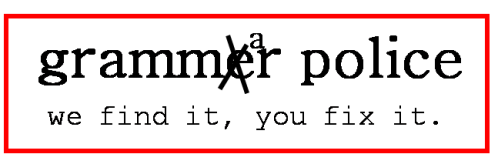
This is our slogan in action: “we find it, you fix it.” Thanks for listening, Chef Michael’s!
Posted in General, GrammarGab (quotes), GrammarGoofs & Gaff(e)s | Tagged advertisement, Chef Michael's, commercial, correct, dog food, English, grammar, language, mistake, object, pet peeve, quote, report, tv, usage, words | Leave a Comment »
June 17, 2011 by grammarcops
A faithful reader shared this with us. We couldn’t resist sharing it with you … enjoy!

Posted in General, GrammarGag Reel (fun stuff), GrammarGarnish (wordplay) | Tagged comic, definition, English, fun, grammar, language, syntax, usage, words, writing | Leave a Comment »
May 21, 2011 by grammarcops
Candidates for the therapy of GRAMMARHOLICS (not so) ANONYMOUS … ? Virtual meetings are available regularly!
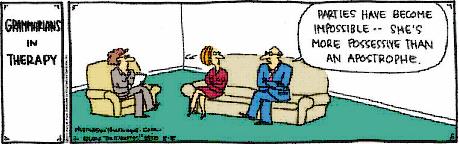
Be sure to visit our friends over at Apostrophe Abuse, Apostrophe Catastrophes, Apostrophism, and, of course, Apostrophe Police, …
Posted in General, GrammarGag Reel (fun stuff), PunctuationPerils | Tagged @GrammarCops, comic, English, fun, grammar, Grammar Police, grammarian, language, punctuation, usage, words, writing | 1 Comment »
May 21, 2011 by grammarcops

Oh my … really? What is our language coming to?
See our series on Nouns gone bad:
Posted in General, GrammarGag Reel (fun stuff), GrammarGarnish (wordplay), GrammarGripes (pet peeves) | Tagged confusion, English, goof, grammar, language, noun, pet peeve, salads, sizzler, usage, verb, vocabulary, words, writing | 2 Comments »
Older Posts »


 Grammar Police a.k.a. GrammarCops
You must be logged in to post a comment.